Grow Light Wattage & Coverage Guide: How Many Watts Do You Actually Need Per Square Foot?
There’s no single correct wattage-per-square-foot number for grow lights, because the right amount depends heavily on what you’re growing and at what stage — but as a practical starting range, low-light foliage and seedlings do well around 10–15 actual watts per square foot, leafy greens and herbs need roughly 20–30, and fruiting or flowering plants generally require 30–50 or more. The key word is “actual” watts, not the inflated wattage many grow light listings advertise.
Why “actual wattage” matters more than the number on the box
Many LED grow light listings advertise a wattage based on the theoretical maximum output of every individual diode combined, rather than what the fixture actually draws from the wall. A light marketed as “1000W” might draw only 100–150W of real power. The number that matters for coverage calculations is the fixture’s actual power draw (listed in the specifications, not the marketing headline), because that’s what correlates with real light output — not the inflated equivalent number used for search visibility.
Coverage by growth stage, not just plant type
The same plant needs different light intensity at different points in its life. Seedlings and clones need relatively little light and can actually be damaged by intense light too early — 10–15 actual watts per square foot is usually enough at this stage. As plants move into vegetative growth, that requirement roughly doubles. Flowering or fruiting stages demand the most light of all, since that’s when plants are converting light energy into the sugars needed to produce flowers or fruit.
- Seedlings & clones: 10–15 actual watts/sq ft — too much light this early can stunt or bleach young growth.
- Leafy greens, herbs, low-light houseplants: 20–30 actual watts/sq ft for steady, healthy growth.
- Vegetative growth (most vegetables, larger houseplants): 25–35 actual watts/sq ft.
- Flowering & fruiting stages: 30–50+ actual watts/sq ft, since this is the highest light-demand phase of a plant’s life cycle.
Distance from the canopy changes the math
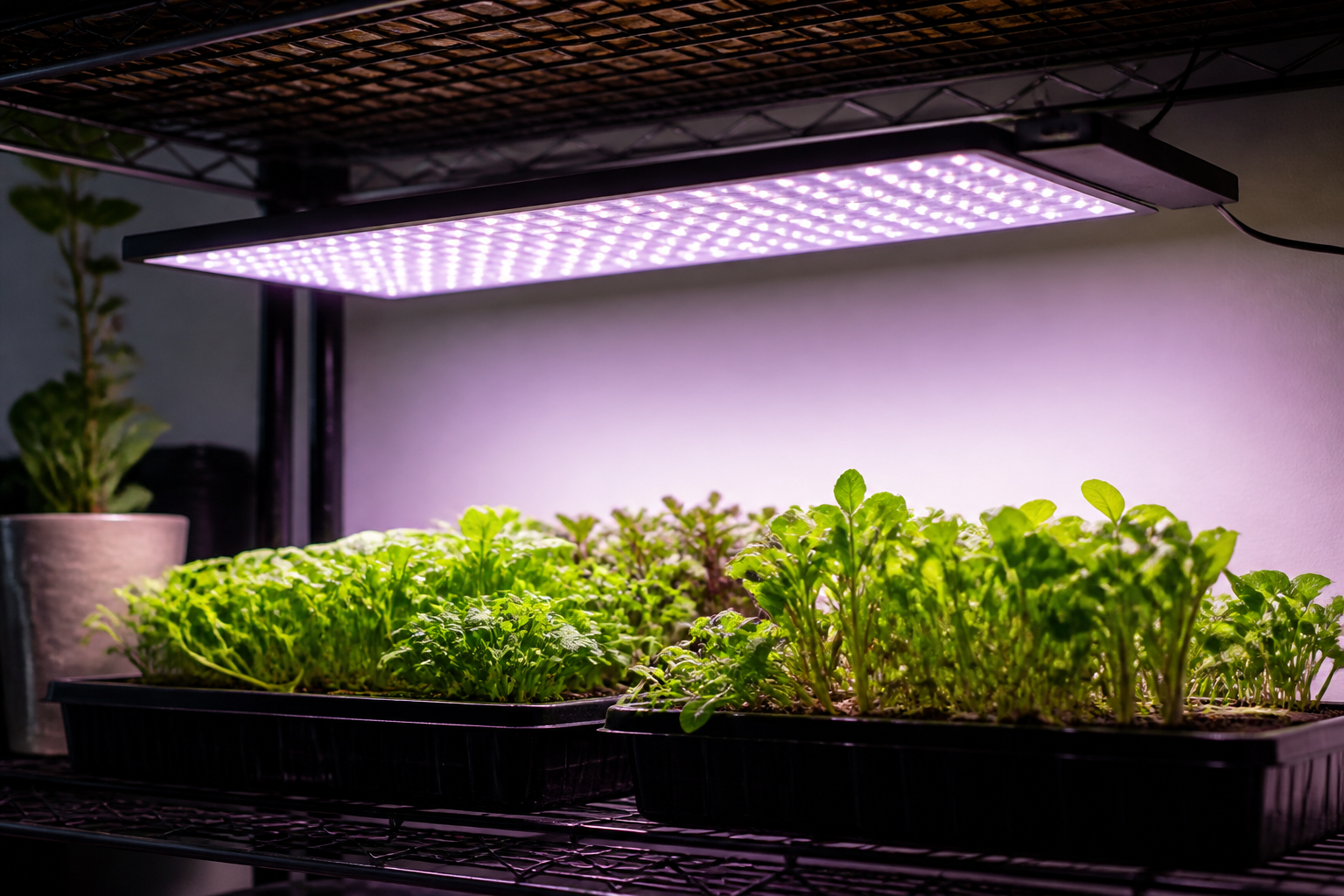
Wattage-per-square-foot figures assume a reasonable, typical mounting height above the plant canopy — usually somewhere in the 12–24 inch range depending on the fixture’s beam angle and intensity. Mounting a light too far above the canopy wastes a large share of its output before it ever reaches the leaves, while mounting it too close risks light burn on the uppermost leaves, especially with high-intensity LED fixtures. Most quality grow lights include a manufacturer-recommended hanging height for a given wattage — that number is usually more reliable than a generic rule of thumb, since beam angle and diode arrangement vary between fixtures.
A common mistake: sizing for the whole room instead of the actual grow area
A frequent miscalculation is sizing grow light wattage to an entire room’s square footage rather than the actual footprint the plants occupy. If plants are clustered on a single shelf or table within a larger room, only that footprint matters for the wattage calculation — lighting the surrounding empty floor space wastes electricity without benefiting plant growth.
Wattage is a starting point, not the only metric
Actual wattage is the most practical starting metric because it’s the easiest for a beginner to find and compare, but it’s a proxy for what actually matters: the amount of usable light (measured as PPFD, photosynthetic photon flux density) actually reaching the leaf surface. Two fixtures with identical actual wattage can deliver different PPFD at the same distance depending on diode efficiency and reflector design, which is why higher-end grow lights increasingly list PPFD or PPF ratings alongside wattage. For most home growers, matching wattage-per-square-foot to the ranges above is accurate enough — PPFD numbers become more relevant once optimizing a dedicated grow tent or serious indoor garden setup.
Matching wattage to a real fixture
Once you know the actual-watt range your plants need for their current growth stage and footprint, the next step is finding a fixture whose real (not marketed) power draw and coverage area match that number. The Best Grow Lights for Indoor Plants comparison lists actual wattage and rated coverage area for each recommended fixture, making it easier to match a light to the calculations above rather than guessing from marketing numbers alone.